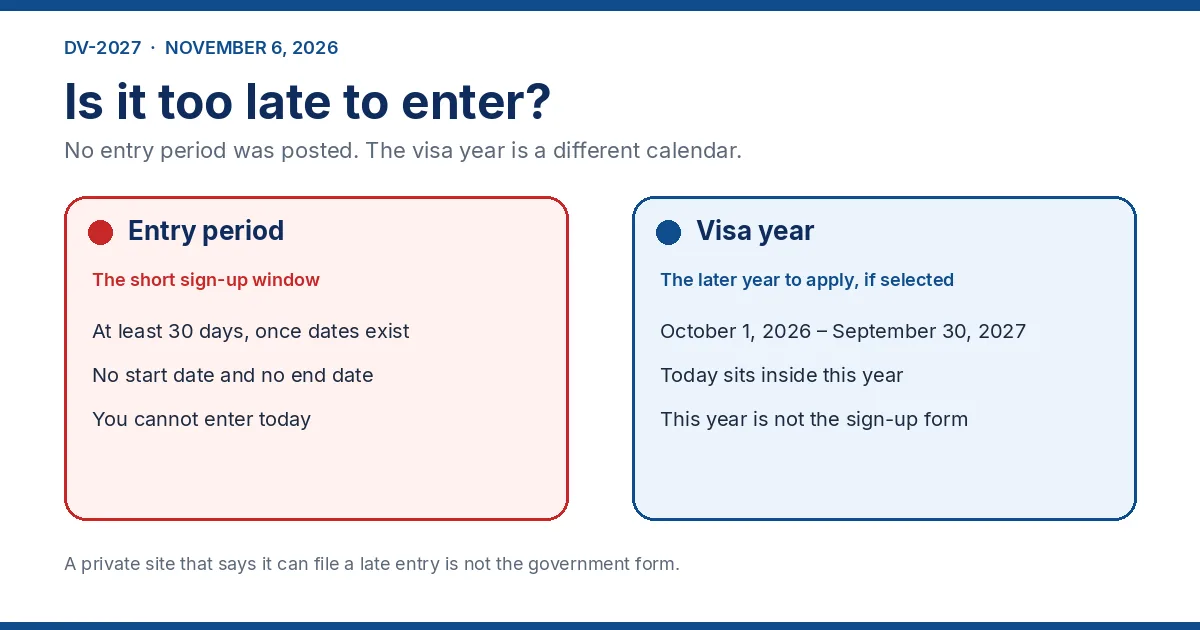
No. It is not too late to enter the DV-2027 lottery, because no entry period was announced. You did not miss a form. You also cannot enter today.
October 1, 2026 is not the day the form opened. It is the first day of the visa year named in the State Department notice from November 5, 2025. The entry period is the short sign-up window. The visa year is the later stretch of time when a selected person may apply for the visa. Those are two different calendars. When does the DV lottery 2027 open? covers the missing opening date.
Did I miss the DV-2027 entry period?
You missed nothing you could have filed.
A real entry period has a start time, an end time, and a website, published by the State Department. DV-2027 does not have those. The notice says the Department will announce the start date “as soon as practicable,” and the date when results may appear in Entry Status Check. “As soon as practicable” means “as soon as the Department can do it.” It is not a day on a calendar.
Think of a school. The form to join the class is handed out in one season. The class itself runs from October 1 to September 30 of a later year. October 1 is the first day of class, not the day the form appears. If the school never handed out the form, you did not forget to turn it in. You also cannot hand a paper to a stranger and call it enrollment.
A website or a person who says “you are late, pay me and I will still file you” is not the government. The DV-2026 instructions said no late entries and no paper entries would be accepted for that program. There is no DV-2027 window to be late for.
What is the difference between the entry period and the visa year?
A fiscal year is the U.S. government year. It runs from October 1 to September 30. It is not the January-to-December year on a wall calendar.
The current diversity visa rule says the Department sets an entry period of at least 30 days during each fiscal year. People who enter in that period are asking to apply for a visa during the following fiscal year. Each year the Department gives notice of the website and the exact dates in the Federal Register, the government’s public journal, and in other ways that spread the news widely.
The last full example is DV-2026. The instructions told people to enter at dvprogram.state.gov from noon, Eastern Daylight Time, on Wednesday, October 2, 2024, until noon, Eastern Standard Time, on Thursday, November 7, 2024. If a person was selected, that person could apply for the visa only during fiscal year 2026, from October 1, 2025 through September 30, 2026. The instructions say there is no carry-over into the next year. The selected-entrants page says a person who did not receive a visa or status by September 30, 2026 derives no further benefit from that registration.
Sign up in one fall. Apply for the visa in the next government year. Stop on September 30.
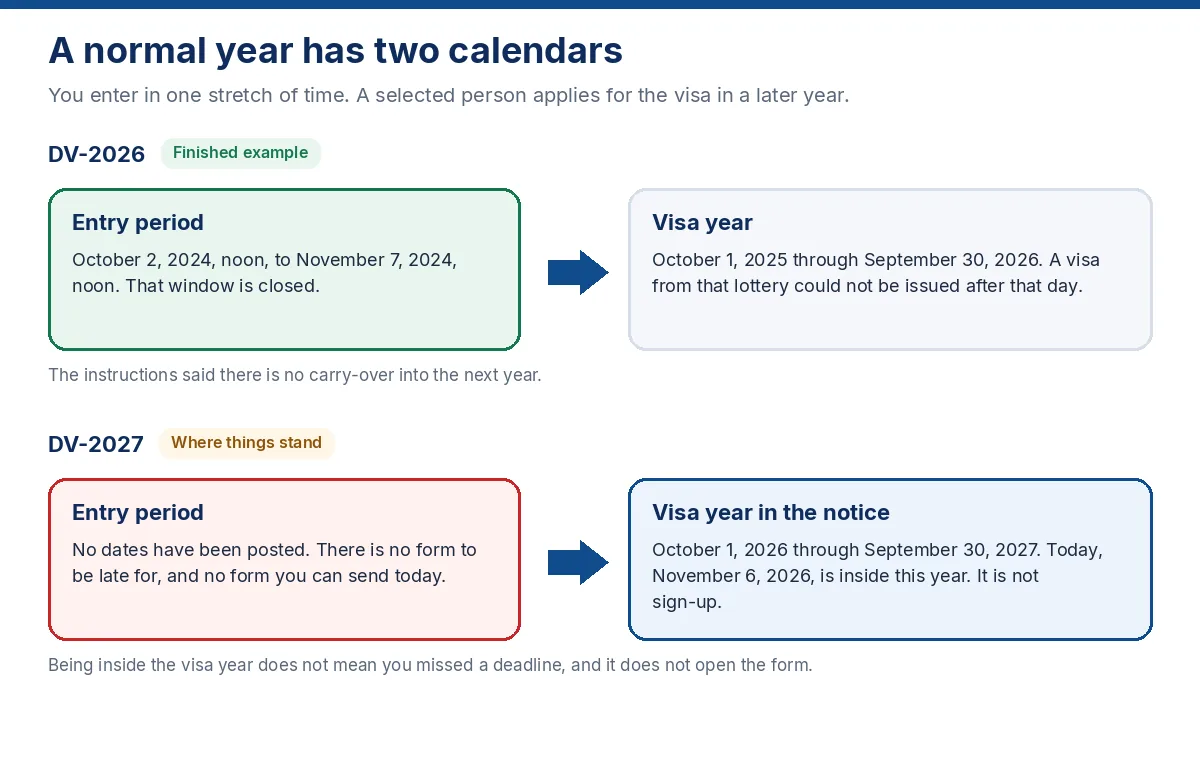
For DV-2027, the November 5, 2025 notice says the changes will not affect the visa application period for people who are selected. That period remains October 1, 2026, to September 30, 2027.
The visa year in the notice has started. Today, November 6, 2026, is inside it. The entry period that would normally come before that visa year was never given dates. The fiscal year in which that period would normally have been held ended on September 30, 2026.
You are not late for a posted form. Being inside the visa year does not open a form.
What do these dates mean for me?
| Date | What it is | What it means for you |
|---|---|---|
| October 2 to November 7, 2024 | The DV-2026 entry period | A finished example. That window is closed. |
| October 1, 2025 to September 30, 2026 | The DV-2026 visa year | Ended. A DV-2026 selection does not carry into DV-2027. |
| September 16, 2025 | The day the $1 registration fee rule took effect | Pay it later, on the official site, only after a real period opens. |
| November 5, 2025 | The State Department notice about DV-2027 | It says the start date will be announced. It names no day. Selected people would have October 1, 2026 to September 30, 2027 to apply. |
| April 10, 2026 | The day the passport and photo rule took effect | These are the current written entry rules, if a period opens. |
| September 30, 2026 | End of fiscal year 2026, when a DV-2027 entry period would normally have been set | That year ended with no DV-2027 dates published. |
| October 1, 2026 | The start of the DV-2027 visa year in the notice | Not an entry deadline. |
| October 29, 2026 | The day an appeals court paused an opening order | November 1 did not become opening day. |
| November 6, 2026 | Today | No entry period is posted. You cannot enter. |
| December 11, 2026 | A court hearing | A meeting for lawyers. Not an entry day. |
| September 30, 2027 | The end of the DV-2027 visa period in the notice | Still ahead. There are no DV-2027 selectees yet. |
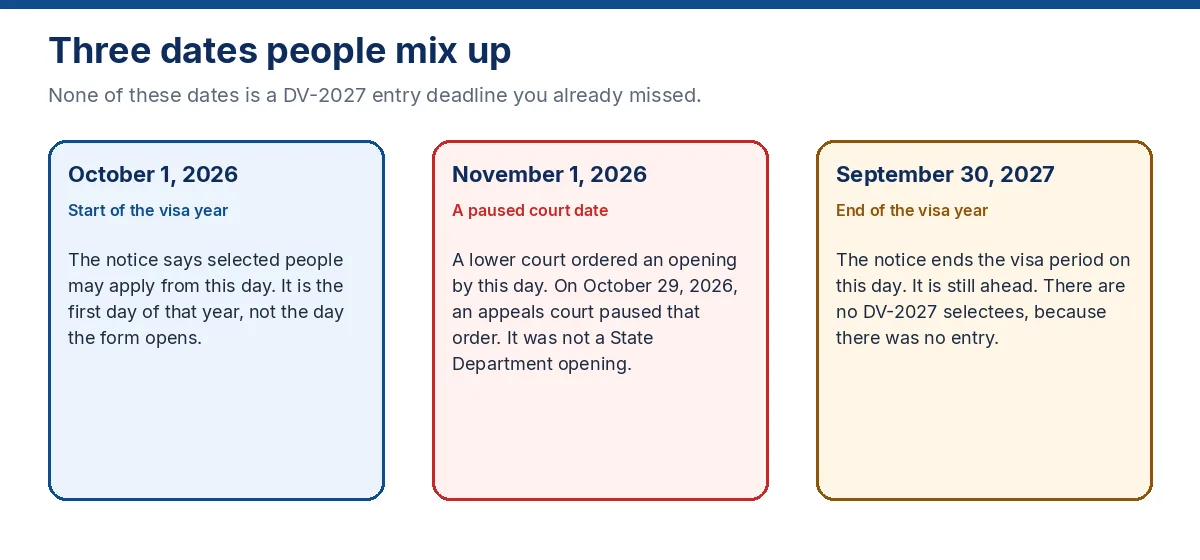
Why was November 1 not a missed deadline?
November 1, 2026 was a date inside a lower court order. That order told the State Department to open registration by that day. The State Department did not announce November 1 as opening day.
An injunction is a court order that tells a government office to do something before the case is finished. Think of a referee who tells a shop to unlock the door while the argument continues. A stay pending appeal is a pause of that order while a higher court looks at it. The door stays as it was during the pause.
On October 29, 2026, the U.S. Court of Appeals for the Ninth Circuit granted that pause in Red Eagle Law v. Rubio, No. 26-6943. The order says the emergency request for a stay is granted. It also says, “We do not endorse the Department’s failure to open the lottery registration period.”
A pause is not a new entry date. It is also not a final decision that the lottery is cancelled. The form stayed closed. Written arguments in that appeal are for the lawyers. They are not days you can enter.
A different case has a hearing on December 11, 2026. A hearing is a meeting on a calendar. It is the conversation, not the sign-up sheet. Does the December 11 hearing open the DV lottery? explains that meeting. You cannot enter that day unless a posted period includes it. No period is posted.
Can an entry period still open this late?
The State Department has not posted a notice that cancels DV-2027. It has not posted dates. The lower court order would have required an opening during this visa year. The appeals court paused that order, and it said the pause is not an endorsement of the closed form. No final ruling says a late DV-2027 entry period can still be held. No final ruling says it cannot.
What you can rely on today is smaller. Until a State Department notice names a website and the dates, you cannot submit an entry. The rule says the Department gives that notice before the period starts. A screenshot in a chat message is not that notice. In recent years the entry site was dvprogram.state.gov. When a notice is posted, use the site it names, and type the address yourself.
The same rule describes an entry period each fiscal year for visas in the following fiscal year. The notice that is posted is about DV-2027. It does not announce dates for a later program year. Do not pay a site that says DV-2028 registration is open.
Does September 30, 2027 close a door I already missed?
No. That day is still ahead of you.
If people are selected, the November 5, 2025 notice gives them from October 1, 2026 through September 30, 2027 to apply. The regulation says eligibility for a diversity visa ends at the end of the fiscal year. It says a consular officer may not issue the visa after the fiscal year in which the person has that eligibility. The DV-2026 instructions used the same kind of end date. They said a person who did not get the visa by that day got nothing to carry into the next year.
There is no DV-2027 selection to expire, because there was no entry. A DV-2026 confirmation number belongs to that finished year. It does not enter you for DV-2027, and it does not open a DV-2027 result.
Selection, if it happens later, is permission to apply. It is not a visa. A real result appears only after you enter, on the status page, when you type the confirmation number from your own entry. The DV-2026 instructions say the U.S. government has never emailed people to say they were selected, and that it had no plans to use email for that purpose for DV-2026. DV-2027 instructions with a results date are not published.
What should you do now?
-
Do not pay for a late entry. There is no posted period. The DV-2026 instructions refused entries after the closing time, and they refused paper entries. A person who says they can still file you is not the State Department.
-
Do not treat October 1, 2026, November 1, 2026, or December 11, 2026 as a day you were supposed to enter. Only a notice with a start time, an end time, and a website is an entry period. September 30, 2027 is still ahead. It is the end of the visa year in the notice, not a form you forgot to send.
-
Ignore a message that says you won. There is no DV-2027 selection. Under the DV-2026 instructions, the government does not email a win, and it does not ask you to send money by mail or by Western Union for this program. There is no win to release.
-
Enter once, and only after a notice names the site and the dates. The current rule says that if two or more petitions are submitted by or for the same person for one fiscal year, all of them are void. That person is not eligible for a diversity visa that year. If the site does not show a confirmation number, the entry was not recorded. When a number appears, stop and save it. Each spouse who meets the rules may submit one entry of their own. That was the DV-2026 instruction. Read the new notice before you file.
-
Pay the government only, on the official payment page, after the form opens. A rule effective September 16, 2025 adds a $1 registration fee, collected at registration through an authorized U.S. government payment portal. The same rule keeps the Diversity Visa application fee at $330. The $330 comes later, and only if you are selected and you apply. The DV-2026 instructions said there was no fee to submit an entry. The $1 rule is the later text. Do not send $1, or any other amount, to a person while the form is closed.
-
Get the passport details ready. The rule effective April 10, 2026 requires the passport number, your name, the country or authority that issued the passport, and the expiration date, unless an exemption in the rule applies. It also requires a JPEG scan of the biographic page and the signature page. A PDF is not accepted. The scan must not be over 5 megabytes.
What photo should I prepare while I wait?
You upload the photo with the entry. A finished photo does not open the form, and it does not mean you were selected.
DV-2027 photo instructions are not published. Two official texts already describe the picture, and they do not use the same ruler.
The rule effective April 10, 2026 says the photo is a color JPEG, taken no more than six months before you submit. You face the camera. The head is not tilted up, down, or to the side. The head covers about 50 percent of the area of the photo. The background is a neutral, light color. The face is in focus. You do not wear eyeglasses, sunglasses, or anything else that blocks the face. A head covering is allowed only when it is worn for religious beliefs, and it may not cover any part of the face. You need a photo of yourself, of your spouse, and of each unmarried child under 21, including a stepchild or an adopted child, even if that person will not immigrate with you. You do not list a spouse or child who is already a U.S. citizen or a lawful permanent resident. The rule says the settings for a scanned print will be specified in the public notice.
The DV-2026 instructions use a file size the newer rule does not repeat: a color JPEG of exactly 600 by 600 pixels, 240 KB or smaller, taken within six months, on a plain white or off-white background, with no eyeglasses. From the chin to the top of the head, the head is 50 to 69 percent of the image height. “About 50 percent of the area” is not the same measure as “50 to 69 percent of the height.” Follow the DV-2027 notice if it chooses one set of numbers.
Because the photo must be no more than six months old on the day you submit, a picture made today can be too old if the form stays closed past six months. Make the file when a real period is announced, or make one now and take a new one if six months pass. How to make a DV lottery photo while you wait compares the two rulers.
The size, file size, and examples pages follow the written rules. The tool on this site exports a 600 by 600 JPEG. dvlotteryphoto.com makes one such JPEG per order, with the background corrected and the file size checked, made to those DV-2026 measurements. Order one file per person who must be listed. That is not State Department approval. It does not submit an entry. It is not the $1 fee. A finished photo does not guarantee selection or a visa.
This is general information from public notices and regulations. It is not legal advice. How this site labels records is on the editorial policy.
Questions
Is it too late to enter the DV-2027 lottery?
No. No DV-2027 entry period was announced, so you did not miss a form. You also cannot enter today. October 1, 2026 is the start of the visa year in the State Department notice, not an entry deadline.
Did the DV-2027 lottery already close?
It did not close, because it never opened. The State Department has not posted a start date or an end date for DV-2027 registration. A private website that says the period is open, or that it can file a late entry, is not the government form.
What is the difference between the entry period and the visa year?
The entry period is the short time when you submit the form. The visa year is the later year when a selected person may apply for the visa. For DV-2027, the November 5, 2025 notice says that visa year is October 1, 2026 through September 30, 2027. The entry dates were not posted.
Does September 30, 2027 mean I already missed my chance?
No. That date is still ahead. It is the end of the visa year in the notice, for people who are selected. There are no DV-2027 selectees, because there was no entry. The regulation says a diversity visa cannot be issued after the fiscal year ends.
Can I use a DV-2026 confirmation number for DV-2027?
No. The DV-2026 instructions said that visa year ended on September 30, 2026, and that there is no carry-over into the next year. A DV-2026 number does not enter you for DV-2027.
What should I do while the form is closed?
Do not pay anyone to enter you now. Wait for a State Department notice that names the website and the dates. You can prepare passport details and a photo. The current rule says the photo must be taken no more than six months before you submit, so you may need a new one if the wait is long. A photo made to the written measurements is not approved by the State Department. It does not submit an entry, and it does not guarantee selection or a visa.
Sources
- 22 CFR 42.33, Electronic Code of Federal Regulations (current compilation). An entry period of at least 30 days during each fiscal year, for visas in the following fiscal year; eligibility ends at the end of the fiscal year; one petition per person; passport, photo, and fee rules. https://www.ecfr.gov/current/title-22/chapter-I/subchapter-E/part-42/subpart-D/section-42.33
- Visas: Enhancing Vetting and Combatting Fraud in the Diversity Immigrant Visa Program, Federal Register, March 11, 2026, effective April 10, 2026. Passport information, the photo rules, and the one-petition rule. https://www.federalregister.gov/documents/2026/03/11/2026-04737/visas-enhancing-vetting-and-combatting-fraud-in-the-diversity-immigrant-visa-program
- U.S. Department of State, “Changes to Entry Period for 2027 Diversity Visa (DV) Program,” last updated November 5, 2025. The start date will be announced as soon as practicable. The visa period for selected people remains October 1, 2026, to September 30, 2027. https://travel.state.gov/content/travel/en/News/visas-news/changes-to-2027-dv-program-entry-period.html
- U.S. Department of State, DV-2026 plain-language instructions. Entry from October 2, 2024 to November 7, 2024, the visa year ending September 30, 2026, no late entries, no carry-over, and no selection email. https://travel.state.gov/content/dam/visas/Diversity-Visa/DV-Instructions-Translations/DV-2026-Instructions-Translations/DV%202026%20Plain%20Language%20Instructions%20and%20FAQs.pdf
- U.S. Department of State, “DV 2026 - Selected Entrants.” The October 2 to November 7, 2024 period, and no further benefit after September 30, 2026. https://travel.state.gov/content/travel/en/us-visas/immigrate/diversity-visa-program-entry/dv-2026-selected-entrants.html
- Schedule of Fees for Consular Services, final rule effective September 16, 2025. The $1 registration fee and the $330 Diversity Visa application fee. https://www.federalregister.gov/documents/2025/09/16/2025-17851/schedule-of-fees-for-consular-services-department-of-state-and-overseas-embassies-and
- U.S. Court of Appeals for the Ninth Circuit, order granting a stay pending appeal, Red Eagle Law, L.C. v. Rubio, No. 26-6943, October 29, 2026. https://cdn.ca9.uscourts.gov/datastore/opinions/2026/10/29/26-6943.pdf
DV Lottery Guide is an independent, unofficial guide and is not affiliated with the U.S. government. A photo made to the written DV requirements is not approved by the State Department. Entering the lottery does not guarantee selection or a visa.