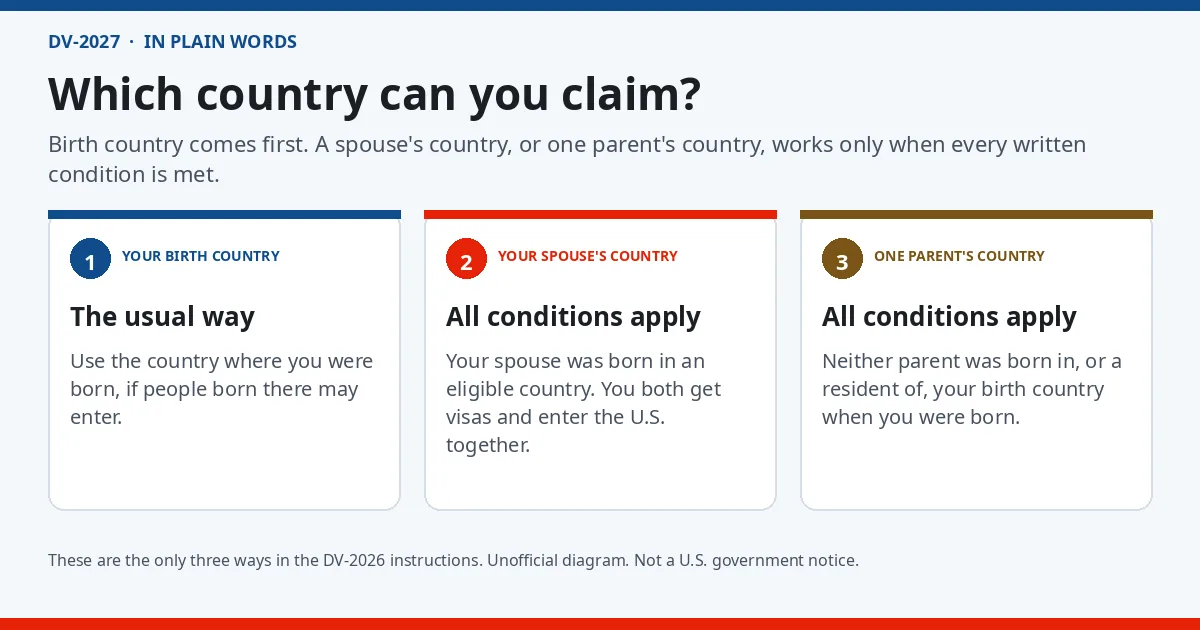
If you were born in a country that cannot enter the Diversity Visa lottery, you may still have a path. You can claim your spouse’s country of birth, or one parent’s country of birth, only when every written condition is met. Those are the only other ways. The country on your passport does not add another way.
DV-2027 instructions are not published yet. The rules below are the last full set, the DV-2026 instructions published on October 1, 2024. If a later notice changes the country list, that notice controls. Registration is not open, so you cannot file this claim today.
Why registration is still closed is in A court paused the order to open the DV lottery 2027. The open-date question is in When does the DV lottery 2027 open?. A photo you can prepare is in How to make a DV lottery photo while you wait.
What does country of chargeability mean?
Chargeability is the country the lottery counts you toward. Picture a team roster. You are counted on one country’s team, usually the country where you were born, because the law limits how many visas any one country can receive.
The instructions call that person a native: someone born in a country, whatever their residence or nationality, or someone the rules allow to count toward a spouse’s or a parent’s country. The table below is the whole list. A country you cannot support will make you ineligible.
Which country should I claim?
Check in this order.
| Step | Country you may claim | When it fits |
|---|---|---|
| 1 | Your country of birth | People born in that country may enter. |
| 2 | Your spouse’s country of birth | Your spouse was born in an eligible country, you are both on the entry, you are both issued diversity visas, and you enter the United States together. |
| 3 | One parent’s country of birth | Neither parent was born in your birth country or legally resident there when you were born, and the parent’s country is eligible. |
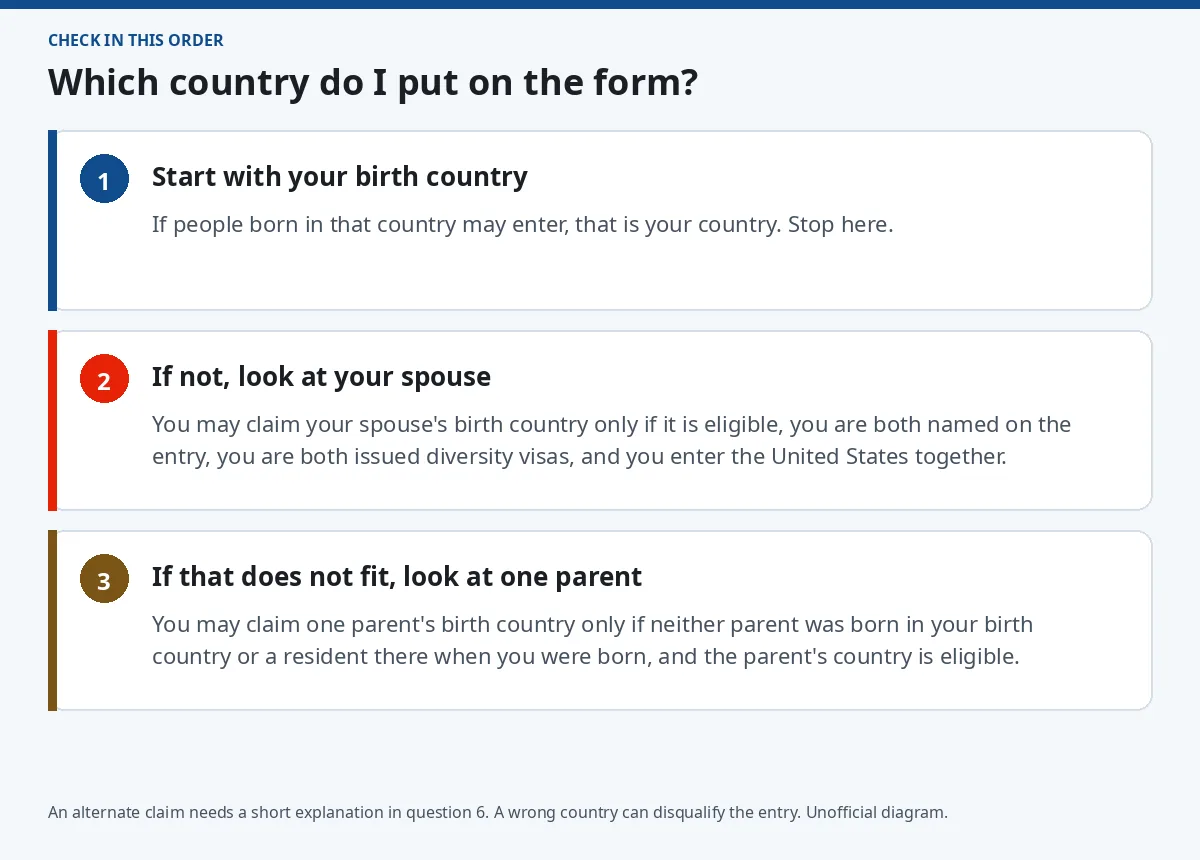
If you use step 2 or step 3, write a short explanation in question 6 of the entry form. Question 6 is the country-of-eligibility question.
Country is only the first test. You also need 12 years of formal elementary and secondary school. A correspondence course or a GED does not count. The work alternative is two years in the past five years in an occupation that needs at least two years of training, in an O*NET range of 7.0 or higher. Do not enter unless you meet both tests. If you miss the second test, your spouse and children are ineligible as derivatives. A derivative applies because of your entry.
Can I use my spouse’s country?
Yes, when every spouse condition is true.
The instructions say you can claim your spouse’s country of birth if your spouse was born in an eligible country. You both must be named on the selected entry, both found eligible, both issued diversity visas, and you must enter the United States together on those visas. You are issued a visa only if your spouse is also issued one.
A spouse who is already a U.S. citizen or a lawful permanent resident does not fit this path. A lawful permanent resident already has a green card. The instructions say not to list that spouse, because that spouse will not be issued a diversity visa.
List your spouse even if you live apart, unless a court order shows a legal separation. A legally separated spouse will not immigrate with you, so that spouse does not fit the spouse path. If you each meet the rules on your own, each of you may submit one entry. If one is selected, the other may apply as a derivative. A second entry in the same person’s name disqualifies every entry for that person.
Can I use my parent’s country?
Yes, if you were born in a country whose natives are not eligible, neither parent was born there, and neither parent was legally resident there when you were born. You may then claim one parent’s country of birth, if that country is eligible. Explain it in question 6.
The instructions say people are not generally residents of a country where they were not born or legally naturalized. A visit, a period of study, or temporary work is not generally residence. A parent born in your birth country does not meet the test.
A minor child can be charged to a parent’s country of birth. That rule is about the child. It is not a fourth country for you.
Which countries were closed for DV-2026?
The DV-2026 instructions say natives of these countries were not eligible, because more than 50,000 natives of each country immigrated to the United States in the previous five years:
- Bangladesh, Brazil, Canada, and China, including people born in mainland China and Hong Kong
- Colombia, Cuba, the Dominican Republic, El Salvador, and Haiti
- Honduras, India, Jamaica, Mexico, and Nigeria
- Pakistan, the Philippines, South Korea, Venezuela, and Vietnam
Macau and Taiwan are eligible. For this program, a person born in Macau derives eligibility from Portugal. Hong Kong is grouped with China.
The United Kingdom, including dependent areas, is on the Europe eligible list. Northern Ireland is listed separately and does qualify. Guatemala is eligible. People born in the Gaza Strip are chargeable to Egypt, people born in the West Bank to Jordan, and people born in the Golan Heights to Syria. Those notes are in the DV-2026 instructions and the plain-language PDF. This list is DV-2026 only.
Is there a DV-2027 country list yet?
No. DV-2027 entry instructions are not published.
The notice from November 5, 2025 says the start date, and the date when results may appear in Entrant Status Check, will be announced as soon as practicable. It does not name countries. A rule effective April 10, 2026 says passport details help officers check place of birth and chargeability. That rule does not publish a country list.
The list can change. Homeland Security counts family and employment immigration over five years, and a country crosses the line at 50,000. Until a DV-2027 notice prints a new list, the DV-2026 list is only the last written list.
| Date | What it means for your country claim |
|---|---|
| October 1, 2024 | DV-2026 instructions publish the country list and the three ways to claim a country. |
| November 5, 2025 | Notice that the DV-2027 start date will be announced later. No country list. |
| April 10, 2026 | Passport rule takes effect. No new country list. |
| October 29, 2026 | Appeals court pauses the order that set a November 1 opening. |
| November 2, 2026 | DV-2027 instructions are still unpublished. |
What should you do now?
-
Wait for the official entry period. The instructions page still describes DV-2026, and that period has concluded. The October 29, 2026 order paused a November 1 opening and posted no entry date.
-
Write down the country you can support. Use your birth country if it is eligible. Otherwise check the spouse path, then the parent path, using birthplaces and where your parents lived when you were born.
-
Read the DV-2027 list before you file. An incorrect country will make you ineligible, and the DV-2026 list can change.
-
Submit one entry in your own name after the period opens. Each eligible spouse may submit one entry. A second entry for the same person disqualifies every entry for that person. Keep the confirmation number yourself. The instructions say the Department will not email a selection notice, and that some helpers keep the number and then demand more money. Check the result yourself on dvprogram.state.gov.
-
Pay the government only, after the official site opens. The October 1, 2024 instructions said the electronic entry had no fee. A final rule effective September 16, 2025 adds a $1 registration fee, in addition to the $330 Diversity Visa application fee. The fee guide compares the two texts. Money paid to a helper to choose your country is not that $1 fee.
Who needs a photo if I claim my spouse’s country?
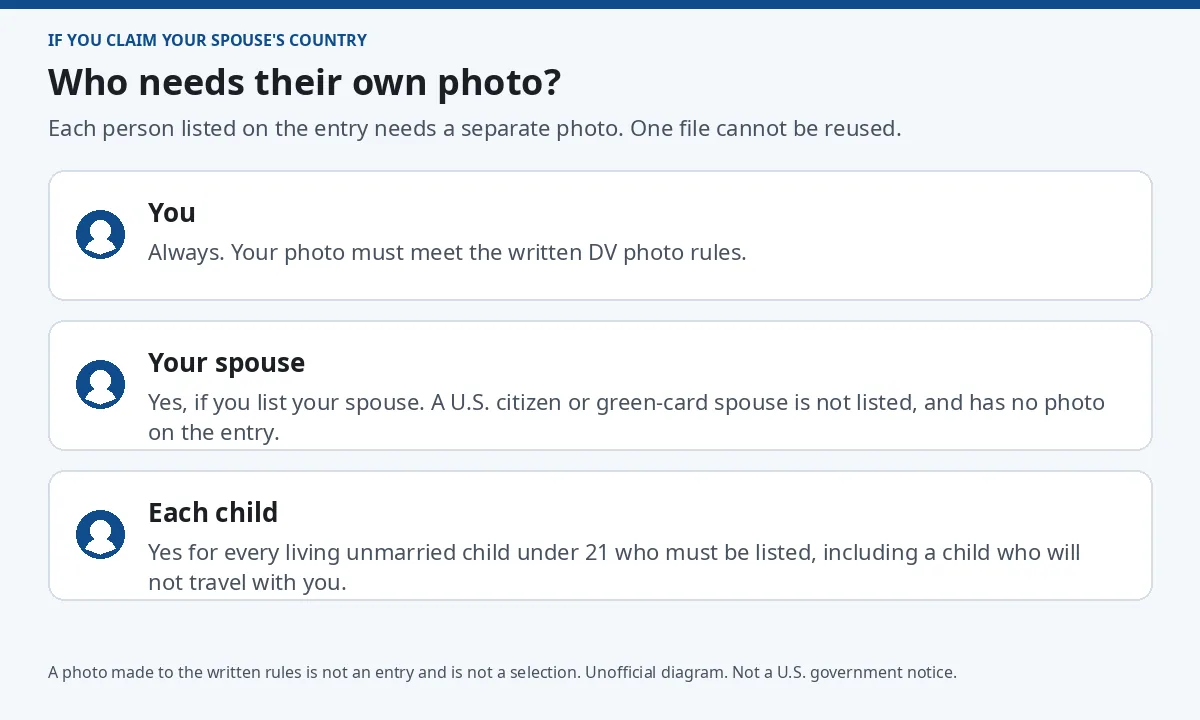
You do. Your spouse does, if you list your spouse. Each child you must list does.
The DV-2026 instructions require a recent photo of you, of your spouse, and of every child on the entry, each under the same technical rules. Skip a photo only for a spouse or child who is already a U.S. citizen or a lawful permanent resident. List every living unmarried child under 21, even a child who will stay behind. Leaving an eligible spouse or child off the entry can disqualify the family.
DV-2027 photo rules are not published. The last full set asks for a color JPEG, 600 by 600 pixels, 240 KB or smaller, taken within six months, head at 50 to 69 percent of the height, and no eyeglasses. A rule effective April 10, 2026 says the head must cover about 50 percent of the photo’s area. Follow the photo guide, the size page, the file size page, and the examples page, and measure again if the new notice picks one set of numbers.
The tool on this site exports a 600 by 600 JPEG. dvlotteryphoto.com makes one such JPEG per order, background corrected and file size checked, to those DV-2026 measurements. Order one file per person: you, your spouse, and each child who must be listed. That is not State Department approval. It does not submit an entry, it is not the $1 fee, and it does not guarantee selection or a visa.
This is general information from public instructions and notices. It is not legal advice. How this site labels official records is on the editorial policy.
Questions
Can I use my spouse’s country of birth for the DV lottery?
Yes, if your spouse was born in an eligible country, you are both named on the entry, you are both issued diversity visas, and you enter the United States together. Explain the claim in question 6. A U.S. citizen or green-card spouse is not listed and cannot be the basis of the claim.
Can I use my parent’s country of birth?
You may claim one parent’s birth country if neither parent was born in your birth country or legally resident there when you were born, and that country is eligible. A visit, study, or temporary job is not generally residence. Explain the claim in question 6.
Does my citizenship pick the country?
Native ordinarily means the country where you were born, whatever your residence or nationality. The only other choices are a spouse’s country of birth or one parent’s country of birth, and only when the written conditions are met.
Is the DV-2027 country list published?
No. The last full list is the DV-2026 list published on October 1, 2024. The November 5, 2025 notice does not publish a DV-2027 country list, and the list can change from year to year.
Can I enter the DV lottery today and claim that country?
No. The State Department has not announced a DV-2027 entry period. On October 29, 2026, an appeals court paused the order that would have required an opening by November 1, 2026.
Who needs a photo if I claim my spouse’s country?
You, your listed spouse, and each listed unmarried child under 21 each need a photo. A U.S. citizen or green-card spouse is not listed. A finished photo does not submit an entry and does not guarantee selection.
Sources
- U.S. Department of State, Diversity Visa Instructions for DV-2026, Federal Register, October 1, 2024. https://www.federalregister.gov/documents/2024/10/01/2024-22482/diversity-visa-instructions-for-dv-2026
- U.S. Department of State, DV-2026 plain-language instructions and FAQs. https://travel.state.gov/content/dam/visas/Diversity-Visa/DV-Instructions-Translations/DV-2026-Instructions-Translations/DV%202026%20Plain%20Language%20Instructions%20and%20FAQs.pdf
- U.S. Department of State, “Changes to Entry Period for 2027 Diversity Visa (DV) Program,” November 5, 2025. https://travel.state.gov/content/travel/en/News/visas-news/changes-to-2027-dv-program-entry-period.html
- Visas: enhancing vetting and combatting fraud in the Diversity Immigrant Visa Program, effective April 10, 2026. https://www.federalregister.gov/documents/2026/03/11/2026-04737/visas-enhancing-vetting-and-combatting-fraud-in-the-diversity-immigrant-visa-program
- Schedule of fees for consular services, final rule effective September 16, 2025. https://www.federalregister.gov/documents/2025/09/16/2025-17851/schedule-of-fees-for-consular-services-department-of-state-and-overseas-embassies-and
- U.S. Court of Appeals for the Ninth Circuit, order granting a stay pending appeal, No. 26-6943, October 29, 2026. https://cdn.ca9.uscourts.gov/datastore/opinions/2026/10/29/26-6943.pdf
- U.S. Department of State, Diversity Visa Instructions page. https://travel.state.gov/content/travel/en/us-visas/immigrate/diversity-visa-program-entry/diversity-visa-instructions.html
DV Lottery Guide is an independent, unofficial guide and is not affiliated with the U.S. government. A photo made to the written DV requirements is not approved by the State Department. Entering the lottery does not guarantee selection or a visa.